 Coin Price India
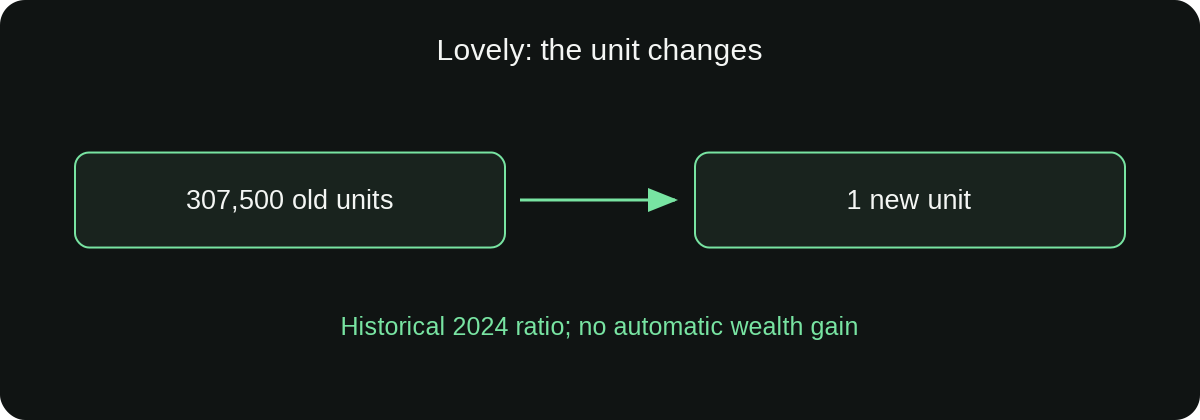
Lovely Inu has a documented 2024 token migration involving 307,500 old units for one new unit. That change alters the unit count; it does not by itself increase the economic value of a holding. First identify which version your balance and chart describe.
The two notices that establish the historical event
Bitget's 21 June 2024 notice announced support for a Lovely Inu migration, including suspended transfers and an exchange ratio. Its subsequent completion announcement, dated 2 July 2024, confirmed the 307,500:1 conversion and identified the replacement ERC-20 contract.
These are dated exchange notices. They establish how that provider described and handled an event, not an unlimited conversion entitlement for every wallet. They also do not confirm that the same provider accepts deposits or serves a particular Indian account today.
The completion notice said old-token deposits would no longer be accepted after the migration. Someone finding the announcement years later must therefore investigate current support rather than sending an old balance to an address on the assumption that conversion remains automatic.
Why fewer units can display a much higher price
Suppose a person held 307,500 old tokens immediately before a purely mechanical redenomination. At the announced ratio, that quantity corresponds to one replacement token. If market value were otherwise unchanged, the new unit would represent 307,500 times as many old units.
The comparison requires both quantity and unit price to be adjusted. Looking only at the price label creates a false impression of a windfall. Looking only at the lower balance creates an equally misleading impression that almost all value disappeared.
The consistency test is simple:
Old quantity × old comparable price = replacement quantity × mechanically adjusted price.
This equality describes the unit conversion before market movements, costs and eligibility differences. It is not a forecast of what an exchange subsequently paid. A new market can trade above or below that mechanical reference.
| Observation | First explanation to investigate |
|---|---|
| Token count fell sharply | Conversion ratio, rather than an unexplained disposal |
| Unit price jumped | Whether the chart changed its denominator |
| Portfolio value changed | Market movement, provider methodology or missing conversion |
| Wallet still shows old units | Custody-specific migration procedure and eligibility |
The important conclusion is economic: compare holdings on an equivalent-unit basis before attributing gains or losses to investment performance.
Audit a chart around the migration boundary
A continuous-looking chart can combine incompatible denominations. Check the provider's notes for a contract replacement, supply adjustment, historical price restatement or discontinued market. Save the original observation rather than silently overwriting it with a new series.
For an analytical spreadsheet, keep separate columns for source unit and comparable unit. Record the conversion factor and effective event date. Applying the ratio twice is just as damaging as failing to apply it at all.
Do not automatically join the last old-market trade to the first replacement-market trade. Different venues, liquidity conditions and trading interruptions can produce a real gap alongside the mechanical change. An adjusted chart should explain its treatment of those differences.
Historical all-time-high comparisons deserve particular care. A percentage calculated against an unadjusted old-unit high answers the wrong question. If the provider does not disclose whether its history is adjusted, mark the comparison unavailable instead of manufacturing a precise recovery percentage.
Your custody arrangement determines the next question
An exchange account holder should obtain the provider's own balance and transaction records. Identify whether it processed the conversion, which asset it now credits and whether there are unresolved account conditions. A social-media screenshot from another customer does not settle your account history.
A self-custody holder needs a different investigation: which contract is held, what migration mechanism was authorised, what deadline applied and whether a supported procedure remains available. The Bitget completion article alone cannot establish those answers for an external wallet.
If a wallet displays both versions, do not add their face values without examining their rights and markets. One may be an obsolete balance. A wallet interface can retain a token entry even when there is no accessible route to exchange it.
Protect yourself from migration-themed requests
A real historical migration gives impersonators a plausible story. A message may offer an urgent final swap, a bonus allocation or recovery of supposedly missing tokens. None becomes trustworthy merely because it repeats the correct conversion ratio.
Start from independently established provider channels. Confirm the exact notice, supported contract and required action. Avoid signing an unexplained approval or importing a seed phrase into a migration page. A support representative does not need your recovery words to examine a published transaction.
Read what a transaction authorises, not just the website's button label. An approval can grant spending rights without performing the promised conversion. If you cannot determine the permission and destination, pausing is more useful than chasing a countdown.
Keep a reconciliation record for India
Maintain acquisition records, old and new quantities, provider statements, transaction identifiers and any fees. Record the factual event separately from your interpretation of its tax treatment. A spreadsheet's adjusted market value is not itself evidence of a bank receipt.
Where the migration affects reporting, ask an Indian tax professional how the actual arrangement should be characterised. Do not infer a universal taxable or tax-free result from an exchange's technical conversion announcement. Ownership, consideration and subsequent transactions require their own analysis.
For future comparisons, use the replacement asset's verified identifier and a clearly labelled historical series. This produces a useful position record even when an exact current quote is unavailable.
Frequently asked questions
Can a token logo confirm that my wallet shows the replacement version?
No. Logos and display names are interface metadata. Use the chain and contract identifier, then reconcile them against an authenticated notice. A familiar image can also remain attached to an obsolete entry.
Should I delete my old acquisition records after conversion?
Keep them. The old quantity, purchase evidence and conversion record explain the origin of the replacement holding. Deleting the earlier history makes later reconciliation harder, particularly when providers export different units.
Can I compare two holders by their token counts alone?
Only after identifying the same version and comparable rights. One person's old-unit count and another person's replacement-unit count are different measures. Compare equivalent quantities before discussing relative holdings.