 Coin Price India
The LPNT price displayed above a chart does not tell you what a full holding will sell for. A realistic estimate uses accessible buy orders, your quantity and the costs of completing settlement. Thin depth can make the average execution price materially different from the last trade.
Establish the asset before studying the book
The LPNTOKEN project profile supplies context for the LPNToken name. For a trading assessment, that name must still be matched to the asset accepted by the venue. A technically correct order-book calculation for an unrelated token is useless.
A third-party profile such as CertiK's LPNT project page provides another category of information. An audit-related page is not a commitment to buy your units and does not guarantee liquidity, account access or market integrity.
Confirm the relevant market, deposit network and current account eligibility before treating visible bids as available to you. A market can be publicly viewable while the reader is unable to deposit or trade there.
Understand what each side of the book means
Bids are orders to buy; offers are orders to sell. A person selling into available demand generally interacts with bids. The lowest offer may be relevant to a buyer, but it is not the price a seller can assume they will receive.
The last trade is another observation. It records a transaction that already occurred, potentially for a small quantity. It does not reserve that price for the next person or guarantee that comparable demand remains.
An exchange's order documentation helps distinguish order behaviour. For example, Kraken's explanation of market and limit orders describes their different execution characteristics. This is general market mechanics, not a claim that Kraken offers LPNT.
The useful questions are therefore side, quantity and timing. Which orders would your sale consume, how many units are available and how current is the snapshot?
Work through a deliberately hypothetical depth example
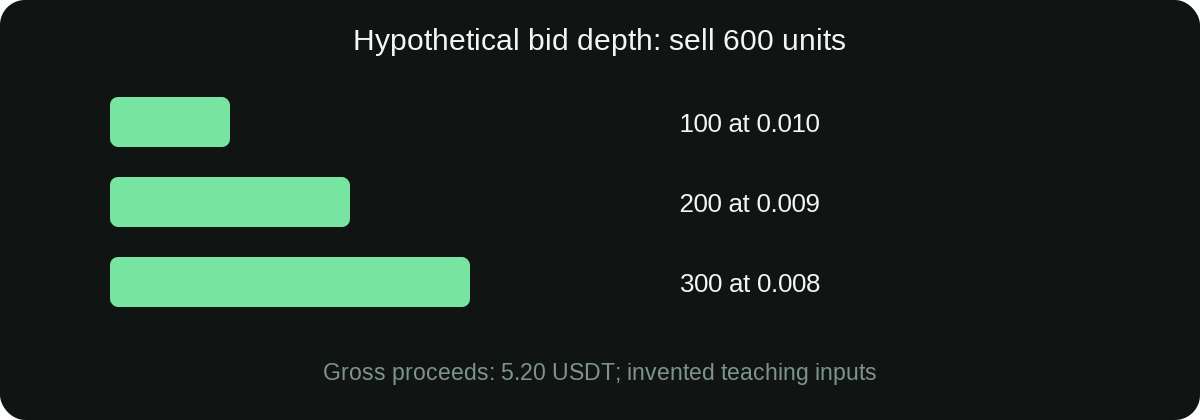
Assume a fictional matching LPNT market has these buy orders. These invented figures explain the calculation; they are not an observed order book, a current quote or original market research.
| Bid price | Units available | Proceeds if fully matched |
|---|---|---|
| 0.010 USDT | 100 | 1.00 USDT |
| 0.009 USDT | 200 | 1.80 USDT |
| 0.008 USDT | 300 | 2.40 USDT |
Selling 600 units against those unchanged bids would produce 5.20 USDT before fees. The weighted average is 5.20 divided by 600, approximately 0.008667 USDT per unit.
Multiplying all 600 units by the best bid would instead suggest 6.00 USDT. That overstates the example's gross proceeds by 0.80 USDT because only 100 units were bid at the top price.
The conclusion is not a prediction of slippage in LPNT. It is a reproducible method: accumulate price multiplied by available quantity across the levels your order would consume, then divide total proceeds by units sold.
What if the book is insufficient?
If visible bids cover only part of the intended quantity, do not extend the final displayed price across the remainder. The unfilled quantity has no demonstrated execution price in that snapshot.
A limit sell order can specify a minimum acceptable price, but it may remain partly or entirely unfilled. Choosing a limit does not create buyers. A market order prioritises execution against available demand and can encounter worse prices than expected.
Published depth can change before an order reaches the matching engine. Orders can be cancelled, other traders can consume liquidity and the market may apply quantity or price restrictions. An estimate is therefore conditional, not a promise.
Check minimum order value and quantity increments. A small position can be economically stranded even when a chart displays a positive price. The venue's rules determine whether the intended order can be submitted.
Extend the estimate through settlement
Gross trade proceeds are not yet bank rupees. Deduct the applicable trading fee, then examine withdrawal costs and the route into the currency you actually need. Confirm whether fees are charged in the sold asset, quote asset or another balance.
For an indicative INR calculation, document the conversion rate separately. A rate quoted for a large stablecoin transaction may not apply to a small residual balance. Minimums can matter more than percentage fees.
Do not subtract tax as a guessed universal platform charge. Preserve transaction records and review the applicable Indian treatment with an adviser. Withholding, reporting and final liability are distinct questions.
A useful worksheet includes gross quantity, filled quantity, average execution price, fees, remaining balance and realised settlement. It makes partial fills visible instead of hiding them inside one portfolio total.
Use depth as one input, not a complete safety verdict
A deep-looking order book does not by itself prove a venue's solvency, permission to serve India or the absence of manipulation. A completed small sale also cannot establish that future larger sales will work.
For the broader token-identification task, see the LPNT price overview. This article answers the narrower execution question after identity and access have been checked.
If current depth cannot be observed reliably, describe the sale value as unverified. An old last price can remain a labelled historical record, but should not be promoted into a current liquidation estimate.
Preserve the observation time and intended order size with any estimate. If you revisit the calculation later, refresh the underlying orders rather than merely changing the date at the top of the worksheet. That keeps a planning record from masquerading as current execution evidence.
Frequently asked questions
Does a stop-loss order guarantee the price I specify?
The trigger and execution conditions depend on the order type. A stop that creates a market order can execute at a different price; a stop-limit can fail to fill. Read the venue's exact rules before relying on either.
Is a partially filled order necessarily an error?
No. It can reflect insufficient matching quantity at the permitted prices. Check the filled amount, remaining amount, order status and any time-in-force condition before submitting another order.
Can reported daily volume replace a depth snapshot?
No. Volume summarises past trading over an interval. Depth describes displayed orders at a point in time. They answer different questions and neither independently guarantees your intended execution.