 Coin Price India
A WAVES-to-INR conversion should distinguish the native coin you own from the portion currently available to spend. Leasing can change the spendable balance without transferring ownership of the leased units. Use the correct balance category before estimating a sale.
What the Waves documentation says about balances
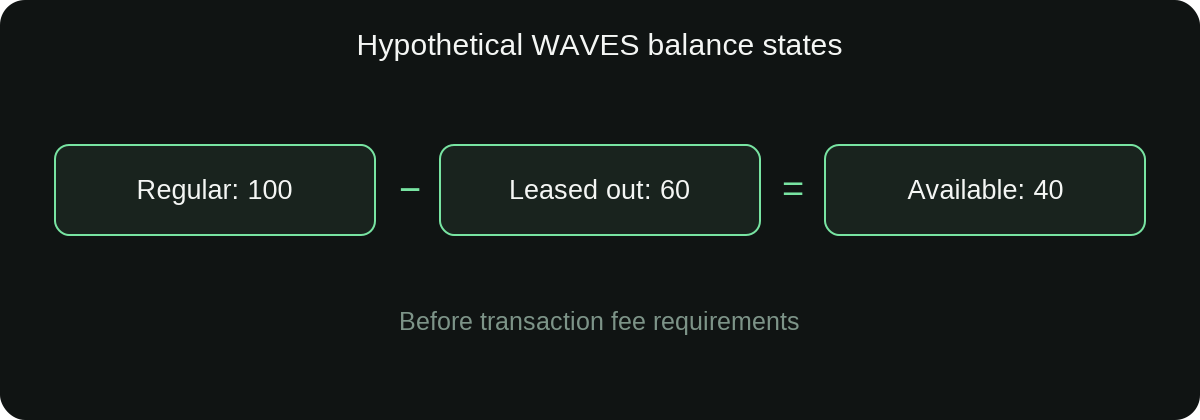
The Waves account-balance documentation distinguishes regular, available, effective and generating balances. In its notation, available WAVES equals the regular balance minus outgoing leased WAVES.
The leasing documentation explains that leasing supports block generation while the leased units remain associated with the lessor's account. It also says payments to lessors are determined by node operators rather than guaranteed by the protocol.
These distinctions matter to a price enquiry. A portfolio reference may consider owned units, while an immediate transfer must respect the available balance and applicable fees. An effective balance used for consensus is not automatically a quantity the account owner can sell.
Match the asset before converting it
The native WAVES coin is different from other assets issued on the Waves network. A wallet can contain multiple assets with different identifiers and prices. A token's presence on the network does not make it WAVES.
Check the asset mapping on the price service and the deposit network on the intended venue. If another chain's representation is involved, investigate its documented relationship rather than assuming the ticker supplies compatibility.
Record the quote currency and market. An INR presentation may be derived from another pair and an exchange rate; it does not establish a direct rupee market or Indian bank settlement.
Only combine the price with a quantity after both refer to the same asset and purpose. This prevents a mechanically correct formula from valuing the wrong units.
Use two quantities for two different questions
For a labelled ownership reference, use the relevant owned quantity with a documented market observation. For an immediate-sale plan, start with the amount that can actually leave the wallet or account under its current conditions.
Consider a deliberately hypothetical account with 100 WAVES in regular balance and 60 WAVES leased out. Under the documentation's formula, 40 WAVES are available before considering the transaction's fee requirements. This example does not assert any particular user's balance or reward rate.
| Question | Relevant quantity in the example | Qualification |
|---|---|---|
| What does the account own? | 100 WAVES | A reference value is not guaranteed proceeds |
| What is unleased? | 40 WAVES | A transfer must still satisfy fee rules |
| What is leased out? | 60 WAVES | Ownership and current spendability differ |
The essential conclusion is that leasing can explain a gap between portfolio value and immediate transfer capacity. It should not automatically be described as missing coins.
Build a transparent INR calculation
For a market quoted in USDT, a reference value is quantity multiplied by USDT per WAVES and then INR per USDT. Keep both rate directions visible, along with the observation time of each.
If the task is selling, substitute accessible bids and account for the intended quantity. Deduct relevant costs and distinguish a venue credit from money settled into your chosen destination.
Do not assume that the lowest transfer fee produces the best complete route. Unsupported deposit networks, minimum order values and settlement conditions can matter more than a small fee difference.
No exact current WAVES rate is supplied here because a synchronised executable Indian route was not tested. Readers can apply the method to verified observations without mistaking a converted chart value for a promised bank receipt.
Treat leasing rewards as a separate cash-flow record
A node's advertised payment policy is different from a protocol-level entitlement. Read how it calculates and distributes rewards, which deductions apply and what evidence supports its operating history.
Do not add projected rewards to the principal balance as if they were already received. Record actual distributions separately. A percentage quoted by a node can change or depend on assumptions that differ from your realised result.
If you need leased units for another purpose, consult the current wallet procedure and chain state for cancelling the lease. Distinguish cancellation, fee availability and the balance categories shown by the interface rather than relying on a generic waiting-time promise.
A cancellation should be authenticated as carefully as any other transaction. There is no need to reveal a seed phrase to a person offering to unlock leased WAVES.
Reconcile wallet, explorer and exchange records
Compare observations at compatible times and heights where available. A wallet connected to a stale node can display information different from a current explorer. A disagreement is a prompt to investigate, not immediate proof of theft.
For an exchange transfer, verify the asset, destination and transaction result, then follow the provider's deposit-credit requirements. The blockchain movement and the exchange's internal accounting are distinct stages.
Keep lease identifiers, cancellation records, transfers and reward receipts. They help explain why a balance changed and support any later Indian reporting analysis. Do not classify all inflows as purchases or all balance changes as disposals without examining the facts.
The reliable INR figure is therefore a labelled calculation attached to an identified asset and balance state. It remains separate from the suitability of leasing, holding or trading WAVES.
If the interface shows both regular and available balances, export or note both before attempting a transfer. That simple reconciliation can prevent an avoidable failed transaction and preserve the explanation for the difference.
Frequently asked questions
Can incoming leased WAVES be treated as my personal investment holding?
Incoming leases can affect consensus-related measures without becoming the recipient's freely owned coins. Review the documentation's balance definitions before including them in a personal net-worth statement.
Does changing a node operator change the price feed?
Not inherently. Node selection and market-data selection are separate choices. A wallet may use different infrastructure for chain state and pricing, so investigate each source independently.
What should I do if a reward arrives in another Waves asset?
Record that asset's identifier and quantity separately. Do not price it as native WAVES merely because the distribution came from a node or appeared in the same wallet interface.