 Coin Price India
A zinc price needs a unit, grade, market and delivery basis. An LME quote in US dollars per tonne cannot be compared directly with an Indian rupee-per-kilogram quote or a scrap dealer's offer. Convert the units first, then reconcile the commercial differences.
Choose the zinc price that answers your task
A manufacturer buying metal, a scrap seller and a derivatives trader need different information. A benchmark can help each person, but it does not replace their actual contract terms.
The LME zinc contract specifications define the standard contract's metal quality, quotation basis and lot. The standard lot is 25 tonnes and the price is quoted in US dollars per tonne. Other LME products can have different terms, so do not generalise that lot to every instrument.
For Indian exchange information, begin with the MCX zinc product page. Check the particular contract and current specification rather than assuming an international lot or settlement rule applies locally.
A supplier quotation introduces another layer: grade, shape, quantity, location, delivery and payment conditions. Those terms explain why a benchmark conversion and a commercial invoice can legitimately differ.
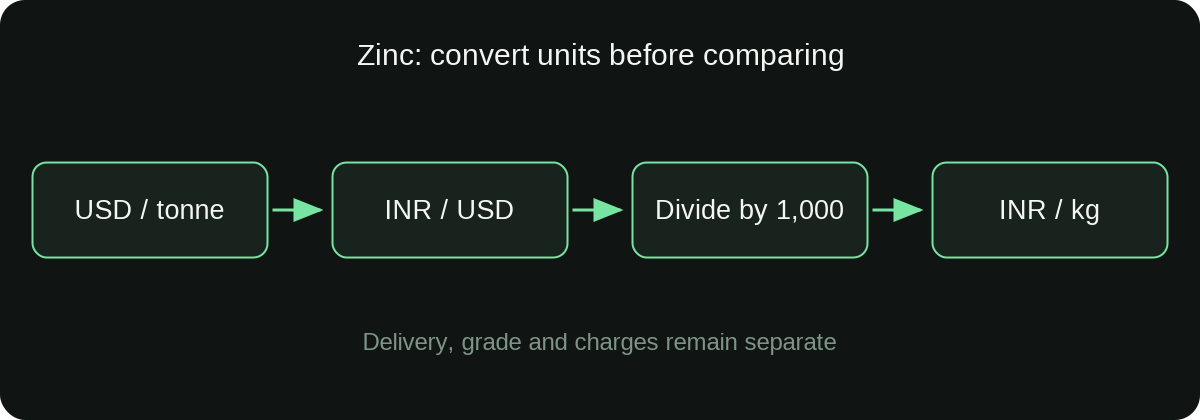
Convert USD per tonne into INR per kilogram
For a clean unit conversion, use:
Indicative INR/kg = USD per tonne × INR per USD ÷ 1,000.
A metric tonne contains 1,000 kilograms. The exchange rate must express rupees for one dollar; reversing that direction produces the wrong result.
For illustration only, assume zinc is 3,000 USD per tonne and the exchange rate is 90 INR per USD. Multiplying gives 270,000 INR per tonne, then dividing by 1,000 gives 270 INR per kilogram.
These are deliberately hypothetical inputs, not today's zinc price or exchange rate. The example demonstrates the arithmetic. Substituting verified observations produces a benchmark-equivalent figure, still excluding commercial adjustments.
| Input or output | Illustrative value | Meaning |
|---|---|---|
| Zinc benchmark | 3,000 USD/tonne | Specified market observation |
| Currency rate | 90 INR/USD | Rupees per dollar |
| Converted benchmark | 270 INR/kg | Metal reference before local adjustments |
The useful conclusion belongs in words as well as the table: a converted benchmark is not a delivered Indian purchase price.
Build a landed-cost comparison
For procurement, request a quote with a consistent basis. Identify whether the seller supplies primary metal, alloy, ingot, sheet or scrap. Record grade and recoverable content where relevant. A lower price for a different material is not automatically a bargain.
Then reconcile transport, insurance, handling, financing and the applicable duties or taxes. Avoid hard-coding a tariff from an old article: classification, origin and current rules can affect the outcome.
State which costs are included in the supplier's quotation and which remain payable separately. Otherwise two suppliers can appear different simply because one includes delivery and the other does not.
For scrap, the expected usable metal and processing requirements matter. Multiplying gross scrap weight by a refined-metal benchmark ignores contamination, recovery losses and treatment costs. Obtain the buyer's assay and deduction terms before comparing net proceeds.
Cash, three-month and futures prices measure different things
A cash reference and a later-dated contract refer to different delivery periods. Their spread can reflect financing, storage, availability and market conditions. It is not a guaranteed forecast that spot metal will reach the later contract's price.
An Indian futures quotation also needs its expiry and relevant contract specifications. Comparing a near-expiry local contract with a three-month international reference without adjustment can produce a misleading apparent premium.
Write the contract date beside the number. If your purpose is procurement next month, a benchmark for another period may be informative but is not a direct replacement for a supplier's matching delivery quote.
Do not interpret every price difference as an arbitrage opportunity. Access, funding, logistics, quality and settlement obligations can prevent an apparent spread from being captured.
Understand exposure before interpreting margin
A futures margin payment is collateral, not the full economic value of the metal exposure. The relevant lot size and price movement determine the gross profit or loss before costs.
Using the standard LME 25-tonne lot purely as a mechanics example, a 10 USD-per-tonne move corresponds to 250 USD of gross change per lot. That calculation says nothing about the margin required or an Indian reader's eligibility to trade the product.
Read settlement and delivery rules before holding any contract near expiry. A convenient chart does not disclose all contractual obligations. For a physical buyer hedging costs, timing and basis risk need attention alongside the direction of the benchmark.
This article does not recommend a derivatives provider or assert permission to use an overseas platform. Access and suitability require separate checks under the applicable arrangements.
Keep a useful zinc price log
Record source, observation time, delay status, unit, grade, contract period and currency. Keep the exchange-rate observation separately. A page that refreshes automatically may still distribute delayed or historical data.
For a supplier comparison, add quote validity, delivery location, included charges and payment terms. Preserve the original quotation so later changes can be traced rather than attributed solely to the global zinc market.
When an input is missing, show the gap. A dated benchmark with clearly stated limitations is more useful than an invented live number. This page provides a comparison method, not a real-time zinc feed.
For procurement reconciliation, retain the supplier invoice weight and the benchmark weight separately. Short delivery or a different weighing basis can change the effective cost per usable kilogram even when the quoted unit price is unchanged.
Frequently asked questions
Is a zinc-company share a substitute for holding zinc metal?
No. A share reflects a company's operations, financing, management and other exposures as well as metal prices. Its return need not track the zinc benchmark proportionately.
Can I compare a galvanised product with the zinc price alone?
No. The product also includes its underlying material, manufacturing, coating specification and commercial costs. Zinc is an input to the price rather than a complete valuation of the finished item.
Why might two suppliers use different benchmark-fixing dates?
Their contracts may specify different averaging periods or pricing events. Compare the written fixing clauses before attributing the difference to margins or assuming either quotation is incorrect.